
3 Years, 2 Inspections: Bunbury Prison Still Facing Staffing, Workplace & Healthcare Pressures
Three years after inspectors raised concerns at Bunbury Regional Prison, a new report records continuing staffing gaps and healthcare pressures alongside improvements in workplace safety and rehabilitation.
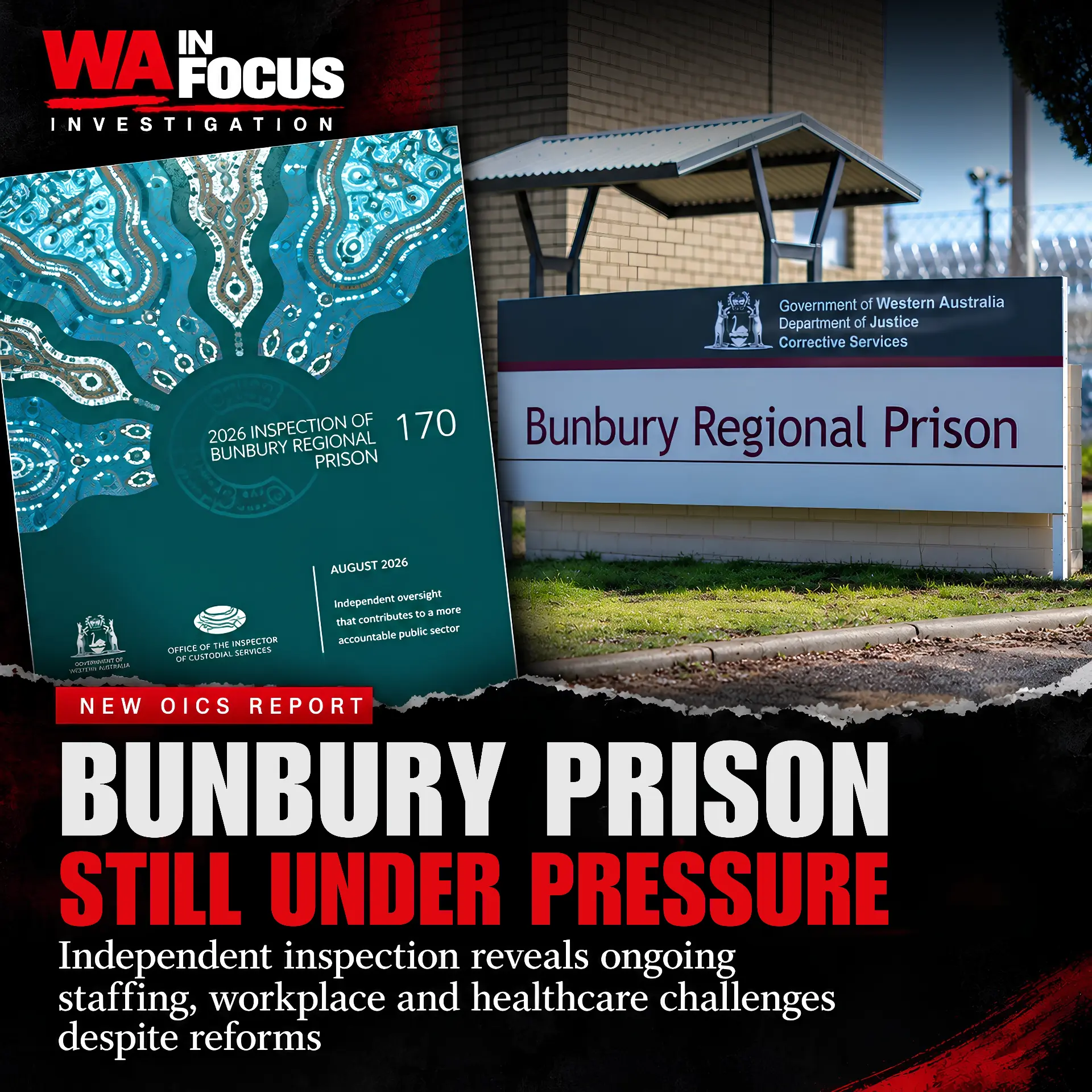
Original report and related investigation
Report 170 was released on 13 October 2026 and records the February 2026 inspection. Its findings should not automatically be taken as describing conditions in October.
- Read the original Bunbury inspection report: OICS Report 170 (PDF)
- View the official report overview and recommendations
- Explore the Bunbury Regional Prison investigation: workplace safety, complaint handling and court records
The investigation is a separate summary of public records, not a finding of liability. Inspection findings do not establish civil allegations. Claims before a court remain allegations and are not proven. WorkSafe announced discontinuance of its prosecution on 23 September 2025. The investigation states its own research cutoff and legal limits.
Three years after independent inspectors raised concerns about staffing, workplace culture and management pressures at Bunbury Regional Prison, a new report has identified continuing challenges affecting staff and prisoners.
The 2026 Inspection of Bunbury Regional Prison, Report 170, released on 13 October 2026 by the Office of the Inspector of Custodial Services (OICS), acknowledges improvements in staff morale, workplace safety and rehabilitation programs.
However, it also documents substantial staffing gaps, unfinished workforce planning, limitations in specialist mental healthcare and delays affecting prisoners' access to rehabilitation.
A WA in Focus comparison with the previous inspection, conducted in July 2023 and published in June 2024, identifies issues that have persisted despite departmental reform efforts.
The new report is based on an onsite inspection conducted between 9 and 13 February 2026. Its findings should not automatically be taken as describing conditions in October.
ALMOST ONE IN FOUR FUNDED STAFF POSITIONS VACANT OR AFFECTED BY ABSENCE
At the time of the February 2026 inspection, 60.5 full time equivalent funded positions, equivalent to 23%, were vacant or affected by staff absences.
Of these, 40 were vacancies across custodial, security, administrative and support roles. Just over a dozen positions were affected by workers' compensation arrangements.
Inspectors reported that staffing arrangements remained based on a 2019 staffing agreement developed for a lower prisoner population.
Staff shortages were affecting everyday operations.
Security employees were reportedly redeployed almost daily to maintain prisoner out of cell time, reducing their availability for searches, surveillance and other security functions.
Education, recreation and prison industries were also affected by redeployments.
In July 2023, inspectors had observed similar pressures, recording staffing shortages of 15 officers against a roster of 60 on one inspection day and 12 on the following day.
The figures from the two inspections are different measures and cannot be directly compared to calculate whether the overall staffing shortage has increased or decreased.
However, both reports establish that staffing limitations affected prison operations during the respective inspections.
STAFFING REVIEW COMMENCED IN 2023 REMAINED UNFINISHED
The Department of Justice commenced a review of public prison custodial staffing in April 2023, intended to develop arrangements capable of meeting existing and future operational demands.
In April 2024, its scope expanded to include non custodial employees, including healthcare and education staff.
The review, known as the Safer Staffing Review, remained incomplete when inspectors visited Bunbury in February 2026.
In its formal response to the new report, the Department said the review was in the final stages, with consultation involving the Western Australian Prison Officers' Union and the Department of Treasury and Finance.
However, the Department also advised that implementing revised staffing agreements would depend on funding availability.
The distinction is important.
Completing a workforce review does not necessarily mean the additional staffing identified through that process has been funded or delivered.
WORKPLACE CULTURE IMPROVES, BUT GRIEVANCE CONCERNS REMAIN
Workplace culture was a significant theme in the previous inspection.
The 2023 report recorded staff allegations of bullying and inappropriate behaviour, along with concerns about management's response.
It referred to a WorkSafe Performance Improvement Notice and reported that some staff lacked confidence in internal complaint processes.
Some employees questioned the rigour of investigations and expressed perceptions of conflicts of interest or favouritism.
Importantly, the inspector expressly declined to determine the merits of those allegations and was satisfied that appropriate grievance avenues existed.
The latest inspection identifies substantial improvement.
Among surveyed staff, the proportion reporting that they mostly felt safe at work increased from 45% at the previous inspection to 88%.
The proportion reporting that staff generally worked well together increased from 55% to 65%.
The report also identifies new procedures, risk assessments, staff training and workplace wellbeing initiatives introduced following a WorkSafe psychosocial hazards improvement notice.
Departmental workplace safety data indicated that reported psychosocial hazards had declined since peaking in 2023.
However, the latest survey showed continuing reservations about workplace grievance resolution.
Of respondents:
- 42% were uncertain about grievance outcomes.
- 29% were dissatisfied.
- 27% believed grievances were resolved.
Only 53% indicated they could raise work related grievances, while 22% felt unable to do so and 23% were unsure.
The survey received 133 responses, representing 50% of staff, in November and December 2025.
These results reflect respondents' perceptions. They do not establish that particular complaints were handled improperly or that allegations of misconduct were proven.
Inspectors nevertheless identified low confidence in grievance processes as an ongoing concern.
FEDERAL COURT PROCEEDINGS FORM PART OF THE BROADER HISTORY
Bunbury Regional Prison has also been the subject of separate legal proceedings concerning allegations of workplace harassment and discrimination.
In Federal Court proceeding WAD 296/2023, former prison officer Bronwyn Hendry brought claims alleging unlawful discrimination and sexual harassment connected with her employment.
Publicly available Federal Court judgments from 2023 and 2025 document procedural developments in that litigation.
Separately, WorkSafe WA commenced a prosecution against the Department of Justice concerning an alleged failure to provide and maintain a safe working environment in connection with psychological injury to a former prison officer.
On 23 September 2025, WorkSafe announced that it had discontinued the prosecution following the receipt of fresh evidence.
WorkSafe also acknowledged improvements in the Department's management of psychosocial hazards and said it would continue monitoring compliance with workplace safety legislation.
The discontinuance did not produce a finding of criminal liability against the Department.
The 2023 and 2026 OICS inspection reports do not determine the allegations raised in the Federal Court proceedings.
They provide separate institutional assessments of workplace processes, staff perceptions and operating conditions.
The latest procedural status of the Federal Court case has not been confirmed in this investigation.
NO DOCUMENTED LOCAL OPERATIONAL PLAN
Strategic planning is another issue identified across the inspections.
The 2023 report found Bunbury lacked a clear strategic or business plan and relied on a management structure that had not undergone a major review for approximately 12 years.
The Department supported recommendations for a statewide strategic plan and a review of Bunbury's management and leadership arrangements.
A Corrective Services Strategic Plan 2025 to 2030 was subsequently introduced.
However, the February 2026 inspection found Bunbury still did not have a documented local operational plan outlining the prison's priorities, values and direction.
Inspectors observed that management's attention was largely directed towards daily operational pressures rather than longer term planning.
This did not mean the facility lacked management or governance arrangements. The report acknowledged functioning management meetings and sound emergency preparedness.
In its formal response, the Department supported the development of a local plan.
It said site specific plans would follow the development and implementation of broader directorate level operational plans.
No specific completion date for Bunbury's local plan was provided in that response.
PSYCHIATRIC CARE: ANOTHER SERVICE INTERRUPTION
The prison's mental health services were also under pressure.
The 2023 inspection identified inadequate mental health provision, including the absence of onsite psychiatric services and the cancellation of a fortnightly telehealth psychiatry clinic.
Subsequent improvements included the appointment of a dedicated Mental Health Nurse in March 2025.
However, the latest report states that psychiatric services ceased again at the end of 2025 following the departure of the prison psychiatrist.
The previous arrangement had provided two half day telehealth clinics each week, seeing approximately five patients per clinic.
In January 2026, 30 prisoners were recorded as requiring psychiatric input.
Of those, one had a serious psychiatric condition requiring intensive or immediate care, four had significant ongoing conditions requiring psychiatric treatment and 25 had stable conditions requiring an appointment or continuing treatment.
The inspector warned that the loss of psychiatric services created a critical gap in specialist oversight.
The Department has acknowledged the difficulty of recruiting psychiatrists across the custodial system.
In its response, it said an internal prison medical officer with a background in psychiatry was providing interim telehealth and consultation support, while negotiations were underway to secure additional external telepsychiatry services.
The Department supported improved psychiatric consultation in principle but said a Bunbury specific service was not feasible given statewide demand.
Whether the proposed additional arrangements are now operating has not been independently confirmed.
OVER 1,100 TREATMENT ASSESSMENTS OVERDUE STATEWIDE
Delays in Treatment Assessment Reports were another significant finding.
These assessments identify prisoners' treatment requirements and inform access to rehabilitation programs and progression through the custodial system.
The inspector reported that, in February 2026, 93 assessments were overdue at Bunbury Regional Prison and 1,108 were overdue across Western Australia's prison system.
The report found that delayed assessments could prevent prisoners from accessing necessary treatment programs and reintegration opportunities, and could affect consideration for parole where treatment requirements remained unmet.
Inspectors also identified approximately 514 lost treatment assessment productivity hours at Bunbury between 2 February and 1 March 2026, attributed to redeployments, leave and vacancies.
The report warned that some prisoners could reach the end of their sentences without completing intended rehabilitation.
It does not establish how many prisoners, if any, remained incarcerated longer solely because of these delays.
In its formal response, the Department confirmed approximately $3.6 million had been approved through the 2026/27 budget process for a dedicated Treatment Assessment Project.
The project was designed to provide 21 additional full time equivalent positions for 12 months, until 30 June 2027, to address the assessment backlog.
The approval establishes a funded response to the problem. Its effectiveness will depend on implementation and subsequent reductions in overdue assessments.
DEPARTMENT HIGHLIGHTS STRONG PERFORMANCE
In its media release on 13 October 2026, the Department of Justice highlighted Bunbury's continuing strengths, including positive staff prisoner relationships, rehabilitation programs, comparatively high out of cell time and improving workplace culture.
These findings are supported by the independent inspection.
The report recognised staff efforts to maintain constructive prisoner activities, minimise unnecessary lockdowns and deliver rehabilitation programs despite limited resources.
It also praised the STEPS alcohol and other drug program as an example of effective treatment and reintegration support.
The Department formally responded to all 15 recommendations arising from the latest inspection.
Three were supported outright, six supported in principle, four were classified as supported through existing practice or projects, one was noted as outside the Department's operational control, and one was not supported.
Several proposed improvements remain dependent on future recruitment, planning or funding.
WHAT REMAINS UNANSWERED?
The two inspections provide a documented record of ongoing operational pressures at Bunbury Regional Prison.
They also show that improvements have occurred.
Staff perceptions of workplace safety have strengthened, psychosocial safety initiatives have been introduced, and the Department has committed resources to addressing treatment assessment delays.
However, significant questions remain about the implementation and effectiveness of those reforms.
When will the Safer Staffing Review translate into funded staffing arrangements at Bunbury?
When will its local operational plan be completed?
What evidence demonstrates that confidence in workplace grievance resolution is improving?
Has consistent specialist psychiatric consultation now been restored?
And how quickly will the funded treatment assessment project reduce the backlog affecting prisoners' access to rehabilitation?
These are questions of institutional accountability rather than findings of individual wrongdoing.
The new inspection establishes that important challenges identified in earlier oversight work continued into February 2026. The Department's subsequent commitments provide a basis against which future progress can be measured.
Source and reporting note
This investigation draws on OICS Reports 153 and 170, the Department of Justice's formal response in Appendix C of Report 170, the Department's media release of 13 October 2026, WorkSafe WA's announcement of 23 September 2025 and published Federal Court judgments.
The findings of OICS are independent institutional assessments. Staff survey responses and allegations in separate legal proceedings should not be treated as established findings of individual misconduct.
The inspection findings principally describe conditions observed in July 2023 and February 2026. Subsequent departmental responses and funding commitments are identified separately.
Got a story for us?
Send a tip or join the conversation in the WA in Focus Facebook group.