
Serious hospital incidents surge 34% as WA health service admits emergency care deterioration
An examination of two parliamentary annual reports reveals a sharp rise in serious clinical incidents across Perth’s eastern public health system, alongside worsening emergency department performance and mounting pressure on hospital beds.
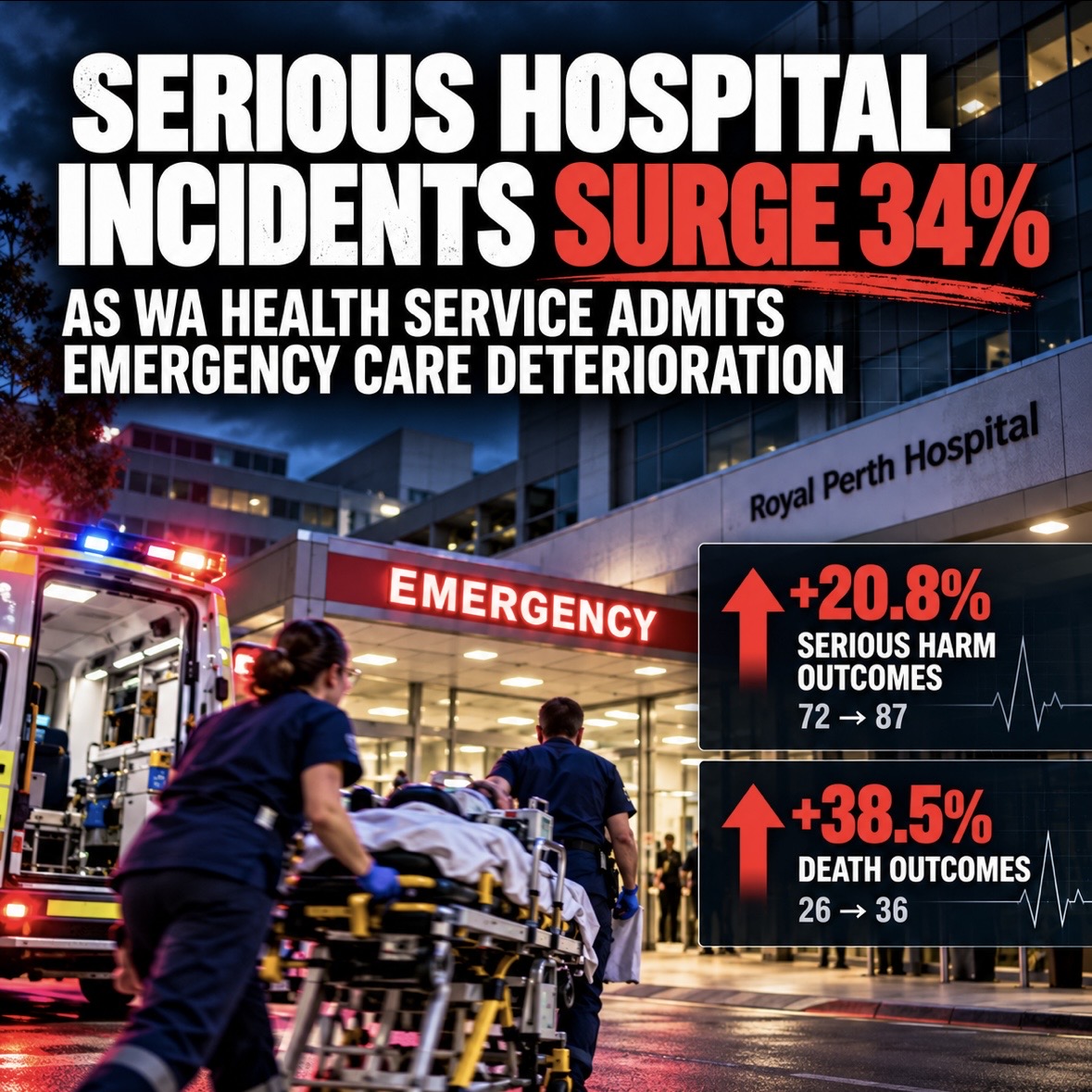
Western Australia's East Metropolitan Health Service has recorded a 34 per cent increase in serious clinical incidents in just one financial year, while acknowledging that emergency department performance has deteriorated across three major hospital sites.
An examination by WA in Focus of the health service's 2024/25 and 2025/26 annual reports identified an increase from 103 to 138 Severity Assessment Code 1 (SAC1) incidents.
These are incidents associated with healthcare delivery that have caused, or could have caused, serious harm or death.
The increase occurred despite hospital admissions growing by approximately 4.4 per cent over the same period.
Although those figures are not directly comparable measures of clinical risk, the difference raises questions about what is driving the increase in reported serious incidents.
The findings relate to East Metropolitan Health Service, which oversees services including Royal Perth Hospital and Armadale Hospital, and contracts public hospital services at Midland.
Serious incidents: the numbers
| Financial year | SAC1 incidents |
|---|---|
| 2024/25 | 103 |
| 2025/26 | 138 |
| Change | +35 (34%) |
Source: EMHS Annual Reports 2024/25 and 2025/26.
The latest report identifies infection control incidents, patient falls and delays in recognising or responding to physical clinical deterioration among the most frequently reported categories.
EMHS attributes the increase in reported SAC1 incidents to increased activity and a strong reporting culture.
That explanation is important. An increase in reported incidents does not necessarily mean the same increase in actual patient harm. Better reporting can identify events that previously went unrecorded.
However, the health service's own report does not provide sufficient explanation to determine how much of the increase resulted from changes in reporting, greater clinical complexity or an increase in harmful events.
Emergency departments under growing pressure
The annual report also contains an unusually candid assessment of emergency department performance.
EMHS states that its hospital sites experienced sustained pressure on patient flow, with ambulance transfer delays, difficulties accessing inpatient beds and deteriorating lengths of stay.
It identifies high acuity presentations, mental health demand and patients awaiting aged care placements as contributing pressures.
Most significantly, the report acknowledges that performance against emergency triage categories two through five continued to deteriorate across Royal Perth Hospital, Armadale Hospital and St John of God Midland Public Hospital, with performance substantially below target.
The health service reported that the most urgent category one presentations continued to be seen on time.
This raises a question requiring further examination: whether delays in recognising or responding to clinical deterioration occurred disproportionately in departments experiencing the greatest patient flow pressures.
The available public evidence does not establish that connection. Nevertheless, the simultaneous deterioration in access performance and increase in serious incident notifications warrants scrutiny.
Patient outcomes reveal a more serious trend
The investigation has identified patient outcome figures in a graphic embedded in the 2025/26 annual report.
They show increases not only in incident notifications, but also in the number of incidents associated with serious harm and death.
| Reported patient outcome | 2024/25 | 2025/26 | Change |
|---|---|---|---|
| No harm | 3 | 11 | +8 |
| Minor harm | 0 | 1 | +1 |
| Moderate harm | 2 | 3 | +1 |
| Serious harm | 72 | 87 | +15 (20.8%) |
| Death | 26 | 36 | +10 (38.5%) |
| Total SAC1 incidents | 103 | 138 | +35 (34%) |
Source: EMHS Annual Report 2025/26, Learning from clinical incidents, patient outcome graphic.
These figures materially strengthen the public interest case for investigating the increase.
In 2024/25, 98 of the 103 SAC1 incidents were associated with a patient outcome classified as serious harm or death.
In 2025/26, that number increased to 123 of 138 incidents.
That is 25 additional incidents associated with serious harm or death, representing an increase of approximately 25.5 per cent.
But an important qualification applies.
EMHS explicitly cautions that the reported patient outcome does not necessarily arise directly from the clinical incident. Other medical conditions and circumstances may have contributed.
Accordingly, the 36 death outcomes must not be described as 36 deaths caused by medical errors. Nor can all 87 serious harm outcomes automatically be attributed to preventable failures.
What the data establishes is that the number of serious clinical incidents associated with these outcomes increased.
That distinction does not diminish the need for answers. It defines precisely what those answers must establish.
What has the health service done?
EMHS says all SAC1 clinical incidents undergo rigorous investigation, with findings reviewed by executive leadership.
The annual report also identifies a range of measures intended to improve safety and patient flow.
These include expanding hospital at home capacity, increasing inpatient beds, introducing bed turnaround teams and extending arrangements intended to reduce emergency department congestion.
Royal Perth Hospital is also participating in a falls prevention research program involving patient education and additional staff training.
These initiatives demonstrate that the health service is responding to identified operational pressures. However, the annual report does not establish whether they have reduced the particular risks associated with the increase in SAC1 notifications.
The questions WA Health still needs to answer
The remaining gaps are sufficiently significant to warrant a formal response from the Minister for Health and East Metropolitan Health Service. WA in Focus has identified six matters requiring clarification.
| Subject | Our questions |
|---|---|
| Hospital level incidents | How many of the 138 SAC1 incidents occurred at Royal Perth, Armadale, Midland and other EMHS facilities? |
| Deaths | Of the 36 incidents associated with a death outcome, how many investigations identified healthcare delivery as a causal or contributing factor? |
| Preventability | How many of the 87 serious harm outcomes were assessed as preventable or potentially preventable? |
| Clinical deterioration | How many incidents involved delayed recognition or response to deteriorating patients, and how did that compare with 2024/25? |
| Investigations | How many SAC1 investigations identified systemic failures, and how many recommendations have been implemented and independently verified? |
| Reporting practices | Were any reporting definitions, classifications, thresholds or procedures changed between the two financial years? |
Answers to those questions would help establish whether the increase principally reflects more comprehensive reporting, greater patient complexity or an increase in serious healthcare related harm.
Why the findings matter
Clinical incident reporting is designed to identify risks, investigate what went wrong and prevent similar events from occurring again.
It is not a measure of individual staff performance, and the available figures do not justify attributing blame to doctors, nurses or other healthcare workers.
But transparent reporting must go beyond recording that an incident occurred.
When a public health service reports 138 serious clinical incidents, including 87 associated with serious harm and 36 with death, the community has a legitimate interest in understanding the causes, what could have been prevented and what improvements have followed.
The simultaneous deterioration in emergency department performance adds urgency to those questions.
WA in Focus assessment
| Finding | Figure |
|---|---|
| Serious clinical incident notifications | Up 34 per cent |
| Incidents associated with serious harm outcomes | Up 20.8 per cent |
| Incidents associated with death outcomes | Up 38.5 per cent |
| Emergency department performance | Deteriorated across three major hospital sites |
What remains unproven is whether these developments are causally connected or whether the increase represents a deterioration in preventable patient safety outcomes.
Sources and editorial verification
This article is based on the EMHS Annual Report 2025/26, the EMHS Annual Report 2024/25 and WA Health's clinical incident reporting definitions.
Got a story for us?
Send a tip or join the conversation in the WA in Focus Facebook group.