
3 universities, one mega merger: What could WA lose?
A proposed merger of Curtin University, Murdoch University and the University of Western Australia could reshape higher education for almost 120,000 students. But with hundreds of millions of dollars in potential restructuring costs, concerns about reduced choice and warnings from South Australia's recent experience, what will the changes mean for ordinary Western Australians?
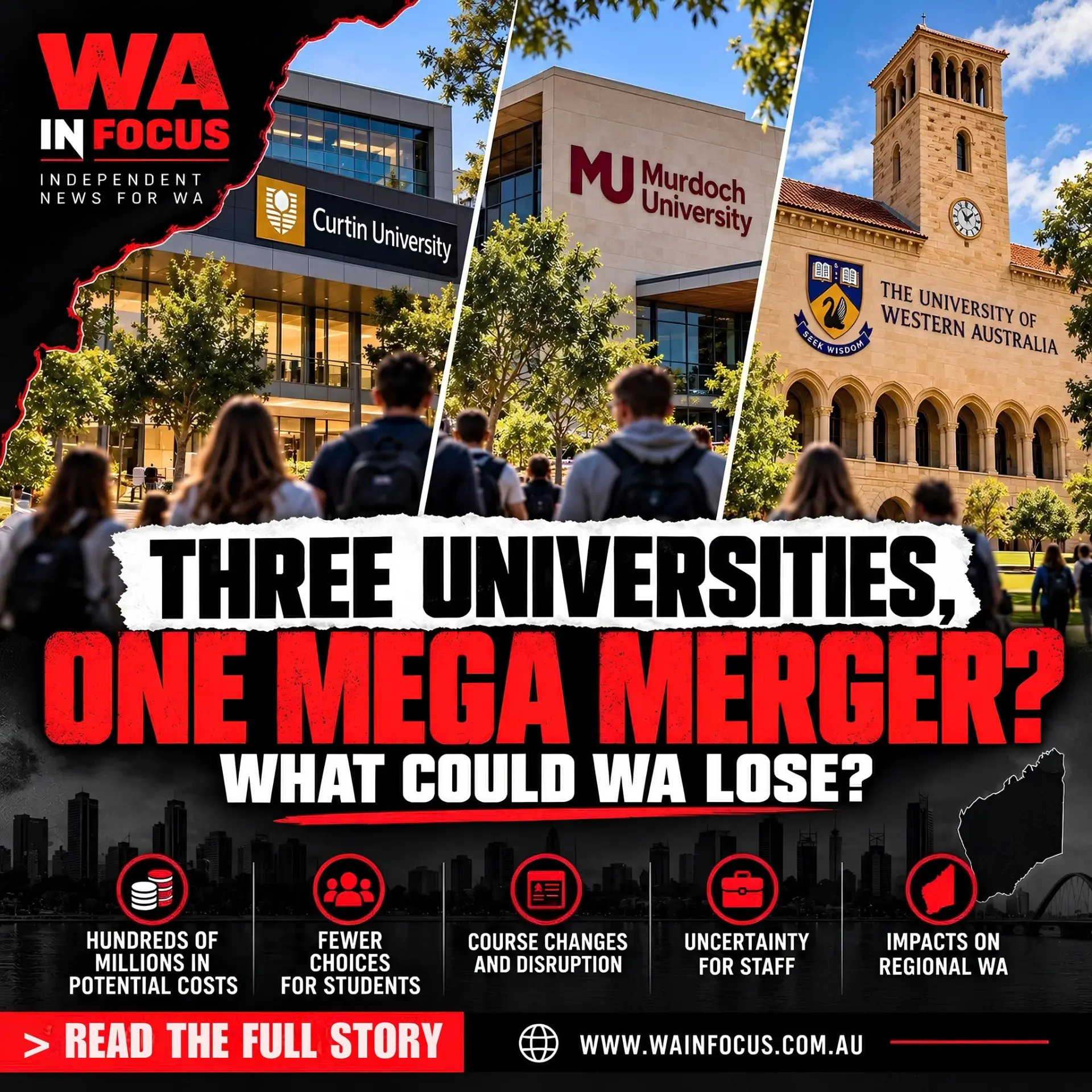
The Western Australian Government is moving forward with plans to potentially combine three of the State's largest universities into a single institution, despite opposition from university leaders and concerns about the consequences for students and staff.
Premier Roger Cook announced on Sunday that a formal business case would examine merging Curtin University, Murdoch University and the University of Western Australia (UWA), with findings expected in 2027.
If approved, the merger would create an institution educating almost 120,000 students, dramatically changing the structure of WA's higher education sector.
The Government argues the proposal could improve research funding, attract more students and strengthen WA's economy.
However, newly released Government studies, university financial records and the recent experience of a similar merger in South Australia raise significant questions about the costs, risks and disruption involved.
Hundreds of millions in potential costs
The Government's own 2025 rapid cost benefit analysis estimates that different university merger configurations could involve costs ranging from $175 million to $522 million, expressed in net present value terms.
Those figures include integration, institutional transformation and support following a merger.
The three university option was identified as offering the greatest potential economic benefits, but also as the most complicated to implement.
The analysis projects that a successful merger could deliver net economic benefits of up to $7.6 billion over 20 years.
However, those benefits are modelled projections dependent on assumptions about education, research, international student recruitment and successful implementation. They are not guaranteed financial returns.
Importantly, the $175 million to $522 million range covers different merger options, rather than representing an approved expenditure commitment for the proposed three university institution.
The Government has not yet established the final cost or how it would be funded.
The business case will examine whether universities could fund the restructuring themselves.
Fewer universities, fewer independent choices
One of the clearest potential consequences is a reduction in the number of independently governed public universities available to Western Australian students.
Curtin, Murdoch and UWA currently operate as separate institutions, each offering its own courses, academic pathways, research specialisations and student services.
Under a three way merger, those institutions would be brought under one university structure.
Edith Cowan University would remain independent.
But students who currently compare Curtin, Murdoch and UWA would have fewer independently governed alternatives.
For students who select a university based on its teaching approach, admission requirements, campus location or particular degree structure, this could have a massive impact.
Course consolidation could also affect students seeking flexibility to balance employment, family responsibilities and study.
Curtin Vice Chancellor Professor Harlene Hayne has publicly opposed the proposal, warning that combining the universities could diminish student choice, disrupt learning and reduce academic diversity.
Curtin has indicated it will vigorously oppose a forced merger.
Murdoch has similarly argued that WA benefits from maintaining four separate public universities, while UWA says any restructuring must demonstrate a compelling business case and substantial benefits for students and the community.
No WA course closures have been announced, and existing students' study arrangements remain unchanged while the business case is developed.
South Australia's merger offers a warning
Western Australia does not need to look overseas to understand the practical challenges involved in combining major universities.
In January 2026, Adelaide University officially opened following the merger of the University of Adelaide and the University of South Australia.
Within weeks, students reported problems involving enrolments, changed course structures, missing study plans and uncertainty about academic credits.
Some students feared their degrees could take longer to complete.
The university acknowledged difficulties and introduced additional support arrangements to resolve the problems.
More serious financial concerns have since emerged.
In September, Adelaide University confirmed it had enrolled 16,677 international students, compared with 20,820 at the equivalent point the previous year across its predecessor institutions.
Its vice chancellor had earlier warned of a projected $90 million revenue shortfall.
The university attributed much of the decline to Commonwealth migration policy changes, including tougher visa settings.
Those policies were outside the university's control and the merger was not established as the cause of the enrolment decline.
Nevertheless, the experience demonstrates how quickly assumptions underpinning a major university restructuring can be disrupted by external circumstances.
Adelaide University and the South Australian Government have also pointed to improvements in international rankings and long term research opportunities as potential benefits of the merger.
For WA, the experience illustrates why financial projections should be tested against adverse conditions rather than relying solely on anticipated growth.
What about university jobs?
Curtin has warned that a merger could threaten jobs and create significant uncertainty for university employees.
Combining three large institutions would potentially involve restructuring administrative systems, academic departments, management arrangements and corporate services.
The WA Government has promised that, if the merger proceeds, there will be no job losses for two years after the new university opens, except for a small number of senior executive positions that will be reviewed.
That provides an initial employment assurance, but it does not establish what will happen after the two year period.
Steering committee chair Mark Barnaba has said the proposal is not intended to achieve savings by cutting jobs.
The future business case will examine staffing arrangements and the composition of the university workforce.
No general redundancy program has been announced.
The challenge will be ensuring any restructuring delivers better education and research outcomes without undermining the staff and specialist services students currently rely upon.
WA universities are already reporting surpluses
There is another important financial consideration.
According to the WA Auditor General's May 2026 report, all four Western Australian public universities recorded financial surpluses in 2025.
The results included approximately:
- Curtin University: $96.5 million
- Murdoch University: $148.3 million
- University of Western Australia: $221.9 million
- Edith Cowan University: $168.2 million
These are reported net results from continuing operations, not unrestricted cash available for a merger.
The Auditor General also warned that universities remain exposed to changes in international student revenue, particularly Murdoch.
Financial surpluses do not eliminate structural problems, and the Government's earlier university reviews identified concerns about research competitiveness, domestic enrolments and course completion rates.
Nevertheless, the audited figures demonstrate that the proposed merger is not being undertaken because all three universities are currently reporting operating losses.
The Government will therefore need to demonstrate why structural consolidation would deliver improvements that could not be achieved through other reforms or greater cooperation between existing universities.
What could regional WA lose?
The Government says a merger could expand higher education opportunities in regional centres including Albany, Kalgoorlie, Bunbury, Geraldton, Karratha, Port Hedland and Broome.
That would potentially benefit students who currently need to relocate or study remotely to obtain certain qualifications.
However, WA's existing universities also maintain distinct specialist facilities and industry relationships.
Curtin's WA School of Mines provides specialist education connected to the State's resources sector, while Murdoch operates WA's only veterinary medicine degree and associated teaching facilities.
Neither program has been identified for closure.
The concern is whether a centralised university would preserve specialist expertise, regional relationships and course accessibility while seeking efficiencies across its operations.
The future business case will need to examine those matters rather than assuming that a larger institution automatically produces better outcomes for regional students.
Government says change is necessary
Premier Roger Cook argues WA must improve the competitiveness of its higher education sector.
The Government's published reform material says more than 15% of Western Australians studying at university are enrolled with interstate institutions, while WA universities attract fewer than two per cent of interstate university students.
It also identifies relatively low course completion rates at some WA universities and difficulties attracting research funding compared with larger interstate institutions.
The Government believes combining resources and research capability could improve those outcomes, strengthen industry partnerships and support economic diversification.
Tertiary Education Minister Tony Buti has argued the sector currently suffers from duplicated courses, fragmented investment and limited scale.
The Government says no final merger decision has been made and that students, staff, unions, industry and university representatives will be consulted during preparation of the business case.
A decision with consequences for generations
This could affect how future generations of Western Australians choose where to study, which courses are available, how universities engage with regional communities and where substantial institutional resources are invested.
The Government's studies identify potentially significant long term benefits.
But the transition costs, implementation difficulties and possible loss of independent student choice also warrant close review.
South Australia's experience shows that even a merger supported by substantial funding and years of planning can encounter serious problems affecting students.
For Western Australia, the issue is whether creating one enormous university would deliver better outcomes than maintaining three separate institutions and improving cooperation.
With the final business case not expected until 2027, that has yet to be demonstrated.
Western Australians will ultimately be left to consider whether a larger university necessarily means a better university, and whether the potential gains justify the financial and educational risks involved.
Got a story for us?
Send a tip or join the conversation in the WA in Focus Facebook group.