32 Recommendations, 1 delivered: WA's $235M Children's Mental Health Overhaul Under Scrutiny
An independent audit found just one of 32 reforms complete by May 2026. WA has committed $235.3 million to the program, but gaps in planning and reporting leave its progress difficult to assess.
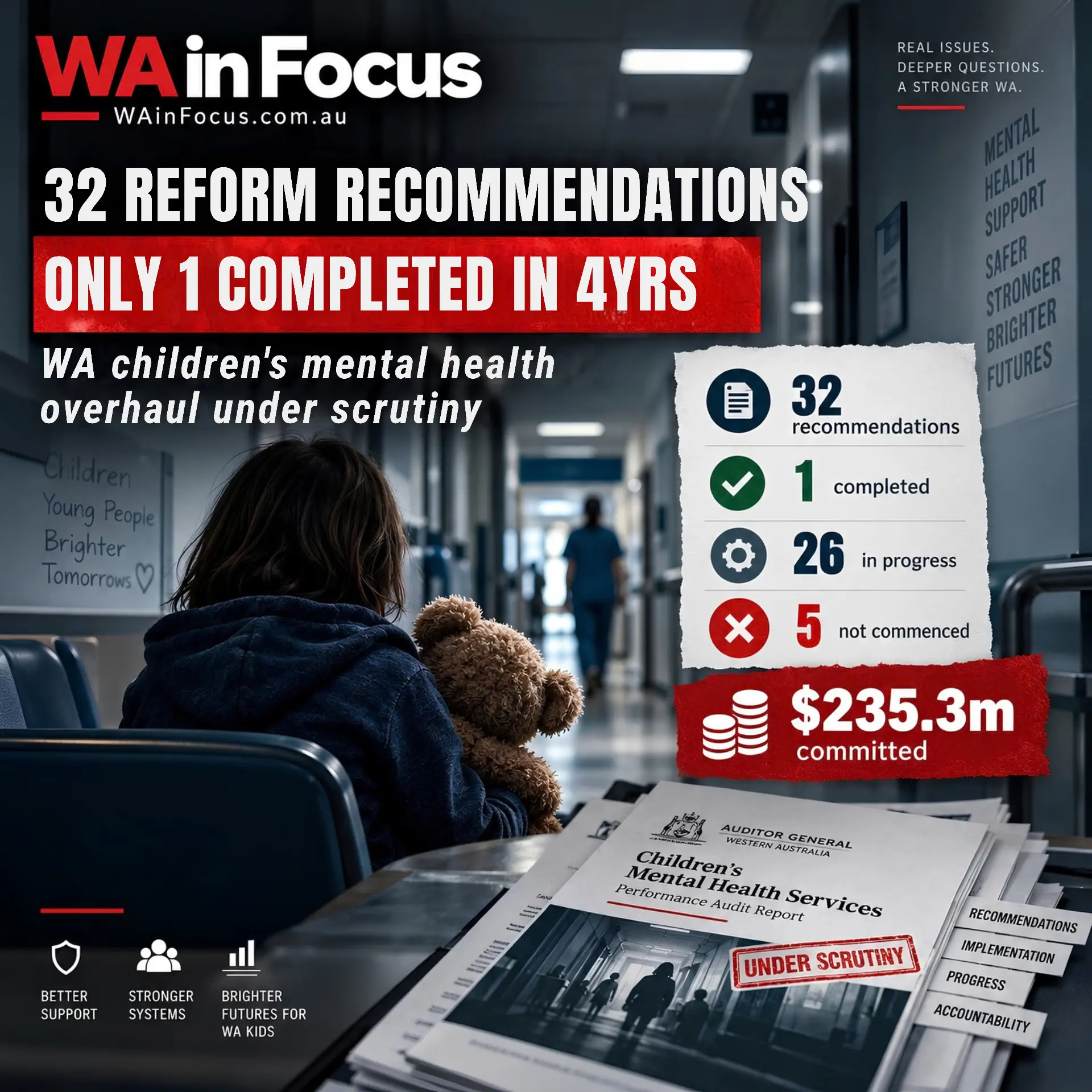
Four years after WA accepted 32 recommendations to overhaul mental health care for children and adolescents, the Auditor General found just one had been fully completed.
The June 2026 audit assessed 26 recommendations as in progress and five as not commenced. It found weaknesses in the Mental Health Commission’s planning and oversight, and warned that progress was insufficient to deliver the program on its existing trajectory.
The Government has stated that it has invested $235.3 million in the transformation since 2022. New services have opened, but auditors could not establish whether the overall program was delivering the intended changes across WA.
The completion figures below are the Auditor General’s assessment as at 28 May 2026, not a verified October total. Subsequent service announcements do not, by themselves, show that more recommendations have been completed.
What the audit found
| Status at 28 May 2026 | Recommendations |
|---|---|
| Completed | 1 |
| In progress | 26 |
| Not commenced | 5 |
| Total | 32 |
The completed recommendation concerned roles, capabilities and career pathways for Aboriginal mental health workers. Ten positions had been funded and at least nine were filled by late May.
Auditors recorded progress in crisis and acute care. Prevention, early intervention and the comprehensive community care model recommended by the taskforce were less advanced.
Not every recommendation was due to be finished by May 2026. The audit’s concern was that the agencies had not demonstrated effective implementation or the intended changes across the system.
How the reforms began
The program followed a 2020 review by WA’s Chief Psychiatrist into the treatment of 13 year old Kate Savage, whose death exposed gaps in public child and adolescent mental health care.
An independent ministerial taskforce was established in 2021. It consulted approximately 1,000 people and released its final report on 15 March 2022.
The Government accepted all 32 recommendations. The taskforce proposed implementation over five years. The Mental Health Commission adopted a nine year program, running from 2023 to 2031.
The Commission’s figures did not match the audit
The number of completed recommendations varied depending on who assessed them and when.
| Assessment | Recommendations recorded as complete |
|---|---|
| Mental Health Commission, November 2025 | 5 |
| Mental Health Commission, May 2026 | 4 |
| Auditor General, as at 28 May 2026 | 1 |
The audit reported that three recommendations previously marked complete had been reclassified as ongoing. It found no clear, consistent criteria for deciding when implementation was finished.
A proposed guarantee of care showed the problem. The Commission had developed the document and counted the recommendation as complete, but auditors found it had not been fully implemented. Clinicians and consumer advocates interviewed for the audit reported no awareness or use of it.
Writing a policy had been counted as delivery before it was being used in care.
Ten recommendations missing from the plans
The Commission’s January 2023 implementation plan omitted 12 recommendations. A workplan endorsed in January 2026 covered some of those omissions, but ten remained unaddressed across both documents.
| Planning measure | Audit finding |
|---|---|
| Recommendations omitted from the January 2023 plan | 12 |
| Recommendations unaddressed across that plan and the January 2026 workplan | 10 |
| Original taskforce implementation period | Five years |
| Commission program period | 2023 to 2031 |
The audit also found incomplete planning for the staff, facilities and funding needed to deliver the reforms statewide.
Demand modelling had not been completed. Without it, the Commission lacked a full picture of where services were needed and what resources would be required. Workforce planning undertaken by the Department of Health in 2022/23 had not been fully implemented by the Commission.
Albany team working from unsuitable premises
The Great Southern Acute Care and Response Team opened in January 2025 and supported 57 young people in its first five months. It introduced outreach arrangements and satellite clinics.
But its temporary accommodation at Albany Health Campus was unsuitable for its intended operations and already at capacity. Recruitment difficulties also restricted expansion.
Auditors acknowledged the work of frontline clinicians. They found that earlier planning for premises and staffing could have reduced these barriers.
Other regions still lacked recommended new local services at the time of the audit. Expanded statewide crisis support had not yet delivered the broader community care model proposed by the taskforce.
What the funding figures show
The Commission’s August 2026 announcement put the Government’s investment since 2022 at $235.3 million. Initiatives included crisis services, community hubs and virtual mental health care.
| Measure | Reported figure and scope |
|---|---|
| Government investment since 2022 | $235.3 million, stated by the Commission in August 2026 |
| Aboriginal mental health worker positions funded | 10, with at least nine filled by late May 2026 |
| Young people supported by the Great Southern team | 57 in its first five months |
| South West community hub clinical staffing | 56.9% increase, measured in full time equivalents |
An evaluation of the South West community hub found increased referrals and favourable consumer feedback alongside the staffing increase.
Those results concern an individual service. They do not establish the effect of the whole reform program.
The Commission had a monitoring and evaluation framework, but had not completed key work on baseline information and consistent progress measures. That limited its ability to demonstrate changes in access or outcomes.
The audit did not conclude that the $235.3 million had been wasted or improperly spent. The investment figure should not be read as a verified breakdown of expenditure. How much has been spent, and how much remains allocated to future delivery, is still a question for the Commission.
Changes announced since June
Dedicated governance arrangements were re established in July 2026 and announced by the Commission in August. They include ministerial oversight, a program delivery group and an implementation working group.
A South West Acute Care Response Team launched in July. The WISH virtual service followed in August, offering specialist support for children and young people in regional and remote WA.
These are developments since the audit. They do not establish a new independently verified completion count for the 32 recommendations.
As at 9 October 2026, WA in Focus had not verified a newer independent assessment replacing the May figures.
The Government’s response
The Mental Health Commission accepted both recommendations made by the Auditor General. These call for renewed governance, a complete plan covering all 32 reforms and better monitoring and public reporting. The target date for implementing the corrective actions is 17 June 2027.
In its formal response, the Commission said the transformation remained a priority and that improvements were making a meaningful difference for children and families. It said major reform required staged implementation.
The Child and Adolescent Health Service and WA Country Health Service also acknowledged the findings, while pointing to improvements in crisis care and regional access.
The Government’s response describes work underway. The audit asks whether that work is being properly planned, measured and delivered.
Our questions
| Subject | Our questions |
|---|---|
| Implementation plan | Has a complete plan covering all 32 recommendations now been approved? |
| Completion count | Which recommendations have been completed since May 2026, and how has completion been assessed? |
| Funding | How much of the $235.3 million has been spent, and what remains allocated to future delivery? |
| Access to care | What are the current specialist waiting times across metropolitan and regional WA? |
| Public reporting | When will consistent progress reports for each recommendation be published? |
| Patient outcomes | What evidence will show whether access and care have improved for children and families? |
The test is not how many services have been announced. It is whether children can get the care the reforms promised, and whether the Government can show what has changed.
Sources
Office of the Auditor General: Progress of the Infant, Child and Adolescent Mental Health System Transformation Program, 17 June 2026.
Ministerial Taskforce: Final Report, March 2022.
https://www.mhc.wa.gov.au/media/4241/ica-taskforce-final-report-2022-final-lr.pdf
Mental Health Commission: New governance announcement, 13 August 2026.
Mental Health Commission: Transformation program and delivery timeline.
Commissioner for Children and Young People: Annual Report 2025/26.
https://ccyp.wa.gov.au/about-us/corporate-information/annual-report-2025-2026/our-future-in-focus/
ABC News: Children’s mental health reform audit, 17 June 2026.
Editor’s note
This article draws on public government findings and subsequent reform announcements. The completion figures are from the Auditor General’s assessment as at 28 May 2026 and are not a verified October total. The audit examined implementation and governance, not individual clinical decisions or patient outcomes. WA in Focus has not obtained a new departmental response specifically for this publication.
Got a story for us?
Send a tip or join the conversation in the WA in Focus Facebook group.