
WA JUSTICE ADMITS IT DOESN’T CENTRALLY TRACK THREATS FROM HIGH RISK OFFENDERS AGAINST SUPPORT WORKERS
Western Australia’s Department of Justice does not centrally collate how many support workers have reported being assaulted, harassed or threatened by High Risk Serious Offenders being supervised in the community.
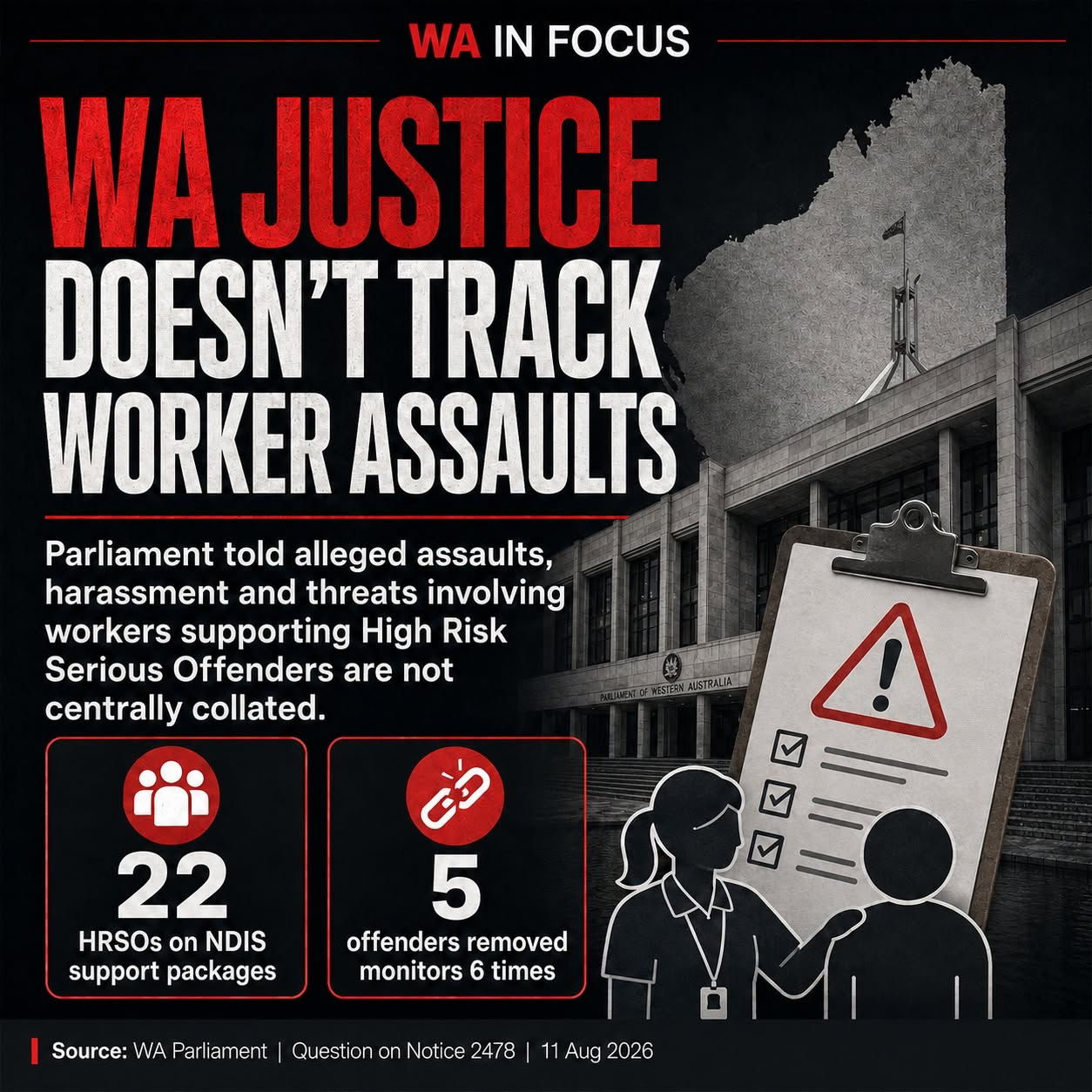
Western Australia’s Department of Justice does not centrally collate how many support workers have reported being assaulted, harassed or threatened by High Risk Serious Offenders being supervised in the community.
The admission was contained in a parliamentary response published on 11 August 2026, after the Government was specifically asked how many NDIS or other support workers had reported assaults, harassment or threats from High Risk Serious Offenders subject to community supervision orders.
Rather than providing a figure, the Department said information about alleged incidents may be recorded within individual case management records, but aggregated statistics are not centrally collated.
The same response revealed that, as at 26 June 2026, 22 High Risk Serious Offenders subject to supervision orders were receiving NDIS support packages.
Of those, 20 HRSOs were receiving accommodation through the NDIS, while a further nine were in accommodation provided through the Department of Justice’s Supported Accommodation Program. The figures do not establish that these are 29 separate individuals, as the groups may overlap.
There is no suggestion that an offender receiving NDIS assistance is doing anything improper as NDIS eligibility relates to disability/support needs.
The significant public interest issue is whether the government agency responsible for managing some of WA’s highest risk offenders has adequate visibility of violence, harassment or threats experienced by the workers supporting them in the community.
THE HIGH RISK SERIOUS OFFENDERS REGIME
Under WA’s High Risk Serious Offenders Act 2020, the Supreme Court can impose ongoing detention or supervision after an offender has completed their custodial sentence.
For a person to be declared a High Risk Serious Offender, the Court must be satisfied that a restriction order is necessary to protect the community against an unacceptable risk that the person will commit a serious offence.
The regime covers serious sexual and violent offenders and replaced WA’s former Dangerous Sexual Offenders legislation.
The parliamentary response also revealed that five High Risk Serious Offenders were responsible for six unlawful removals of electronic monitoring devices between May 2024 and April 2026.
Together, the disclosures provide a rare look at the complexity of supervising high risk offenders outside prison, including the reliance placed on disability, accommodation and other support workers who may have regular face to face contact with them.
For a cohort subject to extraordinary post sentence supervision specifically because of the risk they have been assessed as presenting to the community, absence of centralised worker safety data is significant.
Should the Department of Justice be centrally recording and reporting assaults, harassment and threats against workers tasked with supporting High Risk Serious Offenders in the community?
Got a story for us?
Send a tip or join the conversation in the WA in Focus Facebook group.