4,021 disciplinary allegations substantiated in WA government sector: but what’s behind the rise?
Western Australia’s latest public sector integrity figures reveal thousands of substantiated disciplinary allegations, hundreds of dismissals and dozens of authorities failing to meet whistleblower reporting requirements.
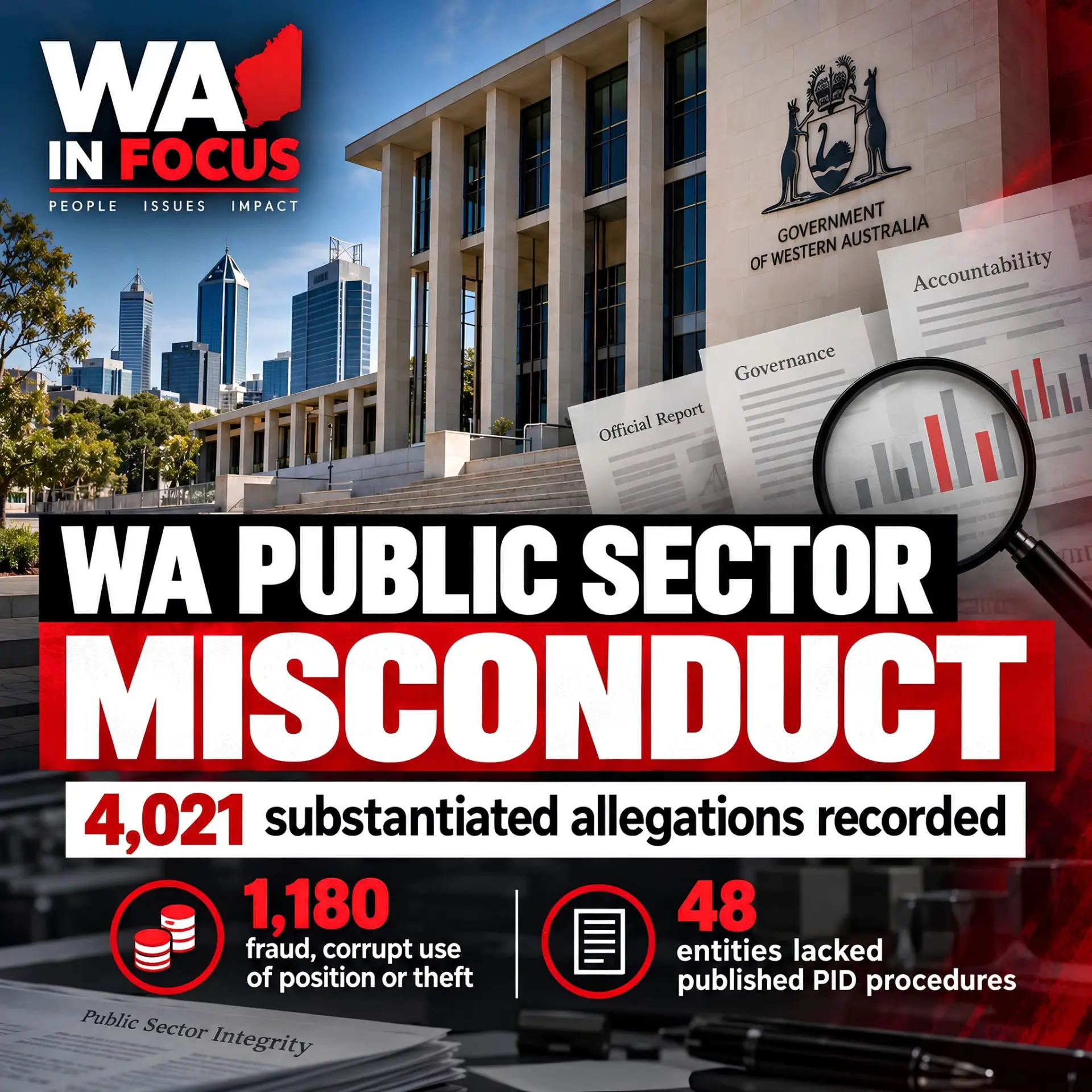
Western Australia's public sector accountability system is facing renewed scrutiny after the Public Sector Commission's latest reports revealed 4,021 substantiated disciplinary allegations across government sector authorities, compared with 2,923 in the previous reporting period.
The figures include allegations involving fraud, corrupt use of position, theft, harassment, bullying and other breaches of workplace discipline.
They also reveal that 351 dismissals were recorded among disciplinary actions and that 48 government sector entities had not published internal procedures required under Western Australia's public interest disclosure legislation.
The findings come after Independent Nedlands MP Jonathan Huston raised concerns in State Parliament earlier this year about increasing misconduct figures and the effectiveness of government integrity safeguards.
Fraud related allegations rise sharply
According to the State of the WA Government Sector Workforce 2025/26 report, the number of substantiated disciplinary allegations increased by approximately 38%.
The report records:
Fraud, corrupt use of position or theft • 446 (2024/25) • 1,180 (2025/26)
Assault, harassment or bullying • 464 (2024/25) • 665 (2025/26)
Offensive or inappropriate behaviour • 613 (2024/25) • 620 (2025/26)
Misuse of public resources or information • 298 (2024/25) • 308 (2025/26)
Careless or negligent performance • 428 (2024/25) • 406 (2025/26)
The most striking change concerns the combined category of fraud, corrupt use of position or theft, which increased from 446 to 1,180 substantiated allegations, representing a 165% increase in the recorded allegation count.
However, the data doesn't mean 1,180 public servants were convicted of corruption, nor do they establish an equivalent increase in the number of people engaging in misconduct.
One health service accounts for much of the increase
South Metropolitan Health Service reported 1,113 disciplinary allegations, of which 1,071 were substantiated.
Those allegations arose from just 92 finalised disciplinary processes.
The Public Sector Commission explains that multiple incidents within individual matters were recorded as separate allegations, producing significantly higher aggregate counts.
More disciplinary processes and dismissals
Although recording practices explain much of the increase in allegation counts, other indicators also changed.
Government sector authorities finalised 2,853 disciplinary processes, compared with 2,502 the previous year.
Of these, 1,917 resulted in at least one substantiated allegation, compared with 1,617 previously.
The report also records 2,548 disciplinary or improvement actions, including:
- 351 dismissals, up from 307.
- 983 reprimands, up from 744.
- 432 counselling or improvement actions, up from 325.
These figures provide additional evidence of disciplinary activity that cannot be explained by counting multiple allegations within one matter.
However, increased disciplinary activity can reflect several factors, including stronger reporting, workforce growth, improved detection or changes in employee behaviour.
83 matters referred for potential serious misconduct
The Commission separately finalised 860 matters reported under its minor misconduct arrangements, an increase from 632.
After assessment, 586 matters were considered potentially within the minor misconduct framework.
Another 83 were assessed as containing allegations of potential serious misconduct and referred to the Corruption and Crime Commission for consideration, compared with 74 the previous year.
Importantly, a referral for potential serious misconduct is not a finding that corruption occurred.
The CCC is responsible for assessing serious misconduct allegations and determining whether further investigation or other action is appropriate.
Of the matters assessed by the Public Sector Commission as potentially involving minor misconduct, 577 allegations concerned assault, harassment or bullying.
These allegations are separate from the substantiated disciplinary allegations reported elsewhere in the document and should not be treated as proven findings.
48 government entities without published whistleblower procedures
One of the strongest accountability findings concerns the protections available to people who report suspected wrongdoing.
At 31 March 2026, the Public Sector Commission recorded 48 government sector entities that had not published internal procedures required under the Public Interest Disclosure Act 2003, increased from 38.
A further 16 authorities reported having no assigned public interest disclosure officer to receive disclosures, although that number had improved from 18.
The legislation establishes mechanisms for people to report specified forms of public interest information, including improper conduct, certain offences and serious misuse of public resources.
Published procedures and appropriately assigned officers are intended to help people understand how to make disclosures and how those disclosures will be handled.
The Commission says it continues to follow up with authorities that have not met these requirements.
Workplace grievances continue to increase
The latest report also shows that government sector authorities completed 1,185 workplace grievances, compared with 1,124 the previous year.
Within public sector agencies specifically, the number increased from 638 to 710.
Grievances encompass a range of workplace concerns.
The proportion of authorities completing at least one grievance process increased from 36.8 per cent to 46.3 per cent.
This could reflect greater willingness to raise concerns, more effective reporting pathways or changes in the underlying volume of workplace disputes.
The Commission reports improvements
The latest findings are not uniformly negative.
The Public Sector Commission reports that 90% of public sector agencies and relevant boards and committees had integrity frameworks meeting the requirements of Commissioner’s Instruction 40, up from 85% in the previous reporting period.
It also reports that 74 of 75 public sector agencies had codes of conduct.
During 2025/26, the Commission delivered 50 integrity education sessions to 1,535 participants, compared with 39 sessions involving 1,265 participants the previous year.
Its annual report also records that 97% of relevant oversight actions were completed within target timeframes, exceeding the 90% target.
These results demonstrate improvements in aspects of the Commission's prevention, education and oversight work.
However, completing an action within its target timeframe does not necessarily establish that the underlying workplace problem has been resolved or that misconduct will not recur.
Got a story for us?
Send a tip or join the conversation in the WA in Focus Facebook group.