22 sex abuse claims: WA youth detention under scrutiny
Allegations that children were sexually abused in WA youth detention have renewed scrutiny of years of inspection warnings about child protection referrals and staff misconduct.
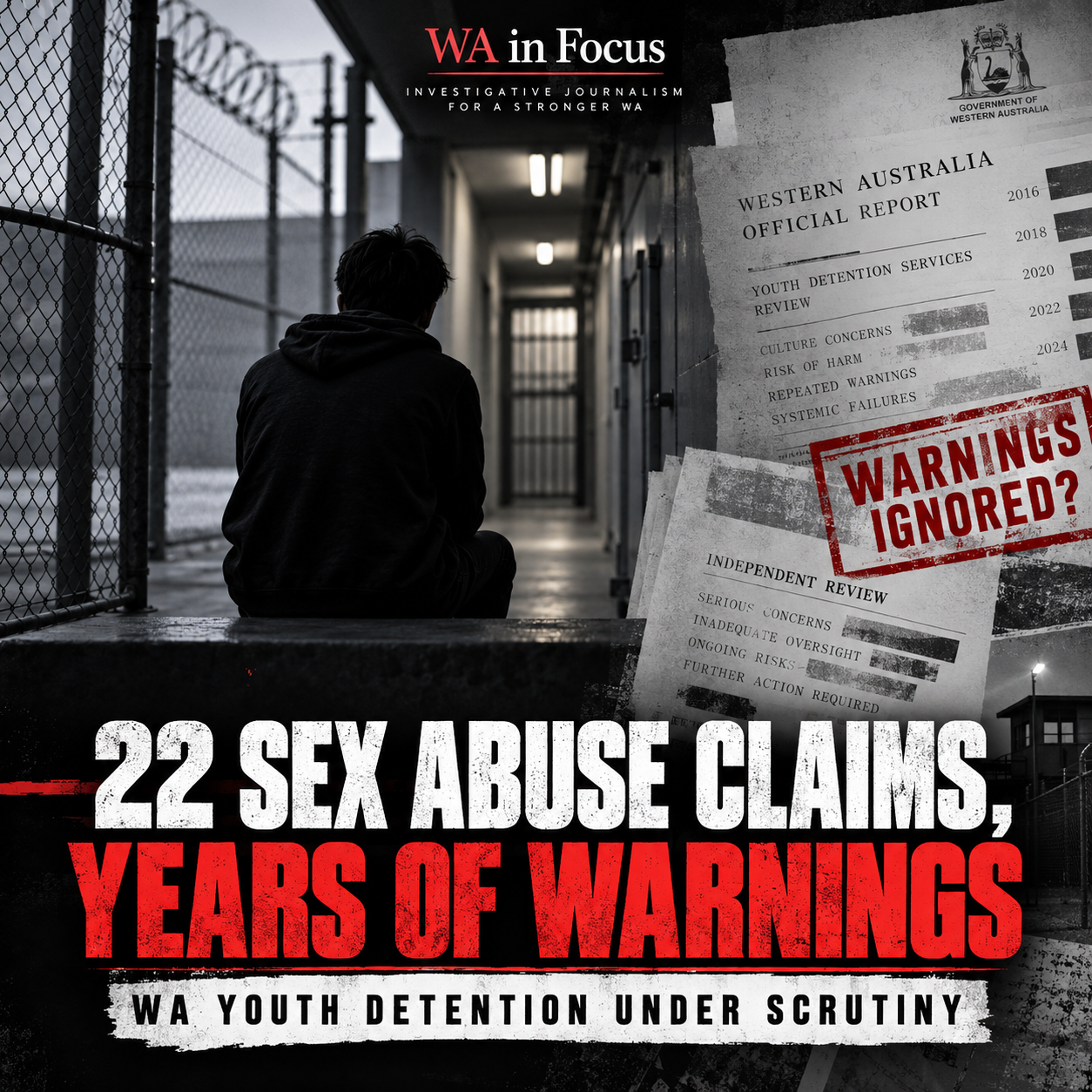
Western Australia’s youth detention system is facing renewed scrutiny following allegations that children were sexually abused by officers responsible for their care, with historical government inspection reports revealing serious shortcomings in child protection referrals, sexual assault procedures and the handling of staff misconduct.
A five month investigation by Guardian Australia, published on 19 October 2026, revealed that one law firm is handling 22 cases involving alleged sexual abuse of children in WA youth detention facilities, dating from 1986 to 2016.
The allegations involve four former and current detention facilities: Rangeview, Riverbank, Longmore and Banksia Hill.
An examination of publicly available reports by WA’s Office of the Inspector of Custodial Services reveals that concerns about safeguarding procedures at Rangeview had been documented years before the latest allegations became public.
In 2005, inspectors identified deficiencies in referrals to child protection services and questioned whether sexual assault medical procedures were appropriate for children.
By 2008, implementation of two recommendations aimed at addressing those issues had been rated poor.
A further inspection in 2010 documented 19 staff misconduct allegations referred for assessment over a 16 month period, including allegations of assault against detainees.
2005: inspectors identify child protection referral concerns
In August 2005, the Office of the Inspector of Custodial Services published Report 29 following an inspection of Rangeview Juvenile Remand Centre.
Although the Inspector assessed the facility positively overall, the report identified concerning gaps in how health staff responded to possible indicators of child sexual abuse.
At paragraph 7.13, inspectors reported that medical staff had detected sexually transmitted infections among detainees, including younger children.
However, medical staff were not routinely notifying the then Department for Community Development or referring detainees to the Child Protection Unit at Princess Margaret Hospital.
Inspectors warned that the absence of routine referrals raised concerns about whether children were receiving appropriate intervention, support and protection from further abuse.
The report also examined procedures for handling disclosures of sexual assault.
Under the policy operating at the time, detainees reporting recent sexual assault were to be referred to a medical officer and subsequently to the Sexual Assault Referral Centre.
Inspectors questioned whether the consent requirements adequately accommodated children who might not have the legal capacity to consent independently to medical treatment.
The Office recommended reviewing those arrangements and improving links with Princess Margaret Hospital to ensure children received age appropriate care.
2008: child safeguarding reforms rated poor
Three years later, the same independent oversight body assessed the Department’s progress against earlier recommendations.
Its April 2008 inspection report, Report 50, included a scorecard examining implementation of recommendations from the earlier Rangeview inspection.
Recommendation 40 called for a review of arrangements with the Sexual Assault Referral Centre, particularly concerning consent to medical treatment for children in custody.
Recommendation 41 called for consideration of closer links between youth custodial services and Princess Margaret Hospital to improve access to comprehensive, age appropriate healthcare.
Both were assessed poor and at the lowest end of the Inspector’s implementation scale.
The findings demonstrate that, several years after the original inspection, the Inspector remained dissatisfied with the Department’s progress on these child health safeguards.
2010: 19 staff misconduct allegations referred
Further concerns emerged in the Inspector’s October 2010 report.
Report 69 examined staff management arrangements at Rangeview and documented changes introduced by a new superintendent.
The Inspector found that there had previously been insufficient compliance with requirements for managing allegations of staff misconduct.
Between January 2009 and April 2010, 19 allegations were referred to the Department’s Professional Standards division.
These matters ranged from general staff misconduct to allegations of assault against detainees.
According to paragraph 5.22, several matters were returned to Rangeview to be managed internally, while only a small number resulted in more serious consequences.
The report acknowledged that the new referral arrangements had improved accountability, although their implementation had caused tension among staff.
There is no basis in this report to claim that the 19 matters were sexual abuse allegations or that all involved substantiated misconduct.
However, the findings independently confirm that concerns about staff behaviour and compliance with misconduct reporting procedures were significant enough to attract formal attention from inspectors.
Historical sexual abuse allegations now emerging
The historical inspection findings have renewed significance following Guardian Australia’s latest investigation.
One former detainee, identified under the pseudonym Aaron, alleges he was sexually assaulted by a youth justice officer at Rangeview when he was 12 years old.
According to The Guardian, Aaron claims the officer initially befriended him and promised protection from violence by other detainees.
He alleges that the same officer subsequently sexually assaulted him on two occasions, including rape.
Aaron, now in his 30s, is preparing civil proceedings against the State of Western Australia, alleging negligence and breach of duty of care.
He has also made allegations concerning sexual assaults at Banksia Hill in 2005. His lawyer says those allegations are not included in his proposed legal action because the necessary records could not be obtained to verify them.
His lawyer, Peter Subramaniam of Chamberlains Law Firm, told The Guardian that his firm is handling 22 historical sexual abuse cases involving WA youth detention facilities.
Questions over access to historical detention records
One of the central concerns raised by Subramaniam involves the difficulty former detainees reportedly face when attempting to access records relating to their time in State custody.
He told The Guardian that obtaining some incarceration records and detention notes had taken years of Freedom of Information requests.
At times, he believed the process appeared deliberately obstructive.
Those claims have not been independently established.
In May 2018, the State Government adopted guiding principles for responding to civil litigation involving historical child sexual abuse.
Those principles state that agencies should facilitate access to relevant claimant records, subject to privacy, legal privilege and other lawful restrictions.
They also call for regular communication with claimants and their lawyers, consideration of early resolution and referral of claims involving serious indictable offences to WA Police.
The document expressly states that the principles are not legally binding and preserves the State’s right to defend claims.
Separately, the State Records Office introduced a disposal freeze on 5 April 2018, covering records relating to actual or alleged child sexual abuse and records concerning the care and supervision of children.
That freeze is designed to preserve potentially relevant evidence.
The State’s own figures confirm extensive historical abuse litigation
The Department of Justice’s 2024/25 annual report confirms that it was defending historical child sexual abuse claims for damages.
The report also acknowledges that some claims are insured while others involve direct financial exposure for the Department, including settlement costs, court costs and legal fees.
Further evidence of the scale of litigation emerged during parliamentary budget estimates on 19 May 2026.
State Solicitor Graham Hill told Parliament that his office had 198 open historical sexual abuse matters and estimated there were approximately 476 open matters across the State’s legal arrangements.
Attorney General Tony Buti also advised Parliament that 466 matters had been settled without proceeding to trial.
These figures relate to historical sexual abuse litigation against the State more broadly and are not figures specifically for youth detention.
The evidence nevertheless confirms that historical abuse litigation represents a substantial and continuing responsibility for the WA Government.
During the same hearing, the State Solicitor said government lawyers and externally engaged firms were required to comply with the applicable model litigant and child sexual abuse litigation principles.
Compensation payments and alleged derogatory language
The Guardian’s investigation also raised concerns about compensation negotiations.
Subramaniam claimed that settlement offers in cases he had encountered were commonly around $75,000.
He further alleged hearing payments described using the derogatory expression “bum money”.
The published account does not establish who used that expression, whether the individual represented the WA Government, or whether it was used during official negotiations.
The Government did not provide The Guardian with a direct response to the question about the terminology.
The Department’s published financial records separately confirm that, during the 2024/25 financial year, the WA Government paid $28,116,614 to 361 applicants under the National Redress Scheme.
The National Redress Scheme operates separately from civil litigation, and those figures cannot be used to establish compensation amounts offered in the detention cases.
Government responds to allegations
The Department of Justice told Guardian Australia that it takes allegations of abuse involving young people seriously.
It declined to comment on Aaron’s individual case because of ongoing legal processes.
Responding to criticism about how historical claims are handled, the Department maintained that it acts in accordance with the State Government’s guiding principles for civil litigation and its obligations as a model litigant.
Calls for an independent inquiry
Former WA Children’s Court president Denis Reynolds has called for an independent inquiry into the management of youth detention in Western Australia.
Speaking to The Guardian, Reynolds criticised the deterioration of conditions in juvenile detention and raised concerns about transparency, governance and the treatment of vulnerable children.
His call adds to questions about whether existing oversight mechanisms have been sufficient to address longstanding problems within the State’s youth justice system.
The latest allegations have also emerged while separate legal proceedings concerning detention conditions at Banksia Hill and Unit 18 continue.
Levitt Robinson Solicitors has publicly reported lodging a representative complaint involving approximately 100 current and former detainees alleging child sexual abuse in juvenile detention.
The firm is separately conducting Federal Court class actions concerning alleged unlawful detention conditions and practices.
Those legal proceedings involve different allegations and potentially overlapping groups of people.
Sources and references
Independent government inspection reports
• Office of the Inspector of Custodial Services: Report 29, Rangeview, August 2005, pages 73 to 74 • Office of the Inspector of Custodial Services: Report 50, Rangeview, April 2008, page 71 • Office of the Inspector of Custodial Services: Report 69, Rangeview, October 2010, page 59
Government and parliamentary records
• Department of Justice: Annual Report 2024/25, pages 56 and 161 • WA Parliament: Estimates Committee, 19 May 2026, evidence of the Attorney General and State Solicitor • State Records Office: Retention requirements and 2018 disposal freeze • WA Government: Royal Commission into Institutional Responses to Child Sexual Abuse, 2018 Progress Report
Original allegations and legal proceedings
• Guardian Australia: Sarah Collard’s investigation, 19 October 2026 • Levitt Robinson / Class PR: Banksia Hill class action and public legal updates
Got a story for us?
Send a tip or join the conversation in the WA in Focus Facebook group.