
WA’s Firearm Licensing System: Built to Regulate, Failing to Function
A $35 million system, a decade in the making, still can’t reliably tell who owns which guns in Western Australia.
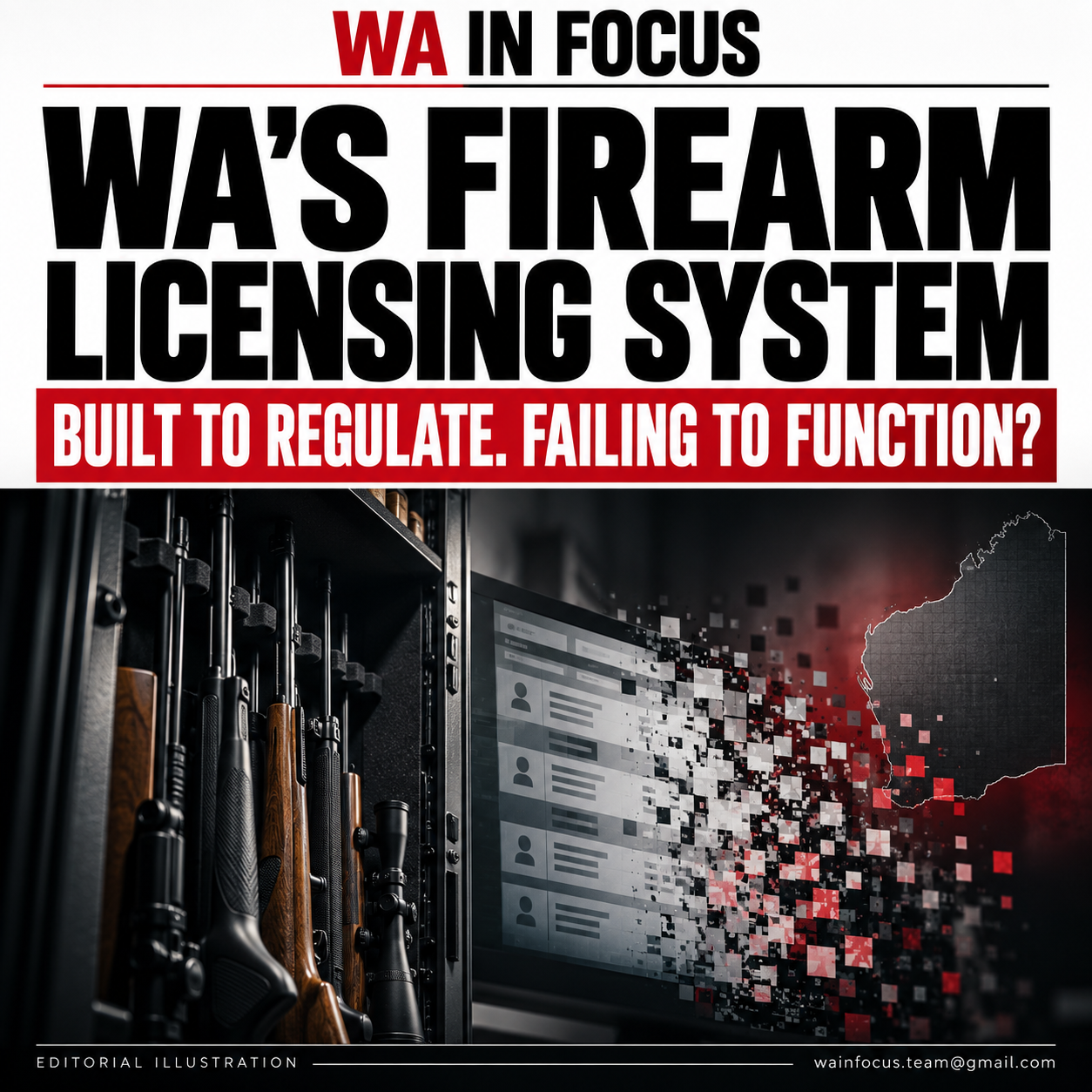
A $35 million system, a decade in the making, still can’t reliably tell who owns which guns in Western Australia.
In 2014, WA Police promised to fix one of the state's most broken regulatory systems: firearm licensing. The old Firearms Registry System, born in a mainframe era and riddled with gaps, couldn’t produce basic reports. It couldn’t track weapons held by deceased owners. It couldn’t even confirm how many firearms were in the state.
A new Licensing and Registry (L&R) system was supposed to change that. It would be modern, internally managed, modular, and under budget. Twelve years later, and over $35 million deep, it still doesn’t work.
What Was Promised
The L&R system began with strong language. WA Police assured Parliament the project would fix decades of audit concerns. The firearms module (the first piece) was scheduled to go live by May 2015 and be completed by November that year. It wasn’t.
By 2016 the system was partially live, but never stable. Parliament’s Public Accounts Committee noted the timeline slippage. WA Police insisted core features were working. Public sector records now show that wasn’t true, and still isn’t.
What Was Built
Auditor General reports in 2019 described a system incapable of doing its most basic job. The registry still couldn’t generate reliable data on the number of firearms or licence holders. The system let staff approve licences without proper rank or legal delegation. No audit trail existed: changes to firearm records could be made with no trace. Approval processes lacked checks; reporting functions were so unreliable staff reverted to spreadsheets.
In short, the L&R system didn’t fix the core risks it was built to eliminate. By 2025, the system still hadn’t met its own revised timeline. A new Firearms Act forced more delays, pushing full delivery to 2026. Police confirmed the portal had technical breakdowns, address issues, and identity verification failures.
What It Cost
The original project budget was $8.8 million. As of 2025, the state has spent over $11.1 million, with a total program cost now projected to exceed $35 million. That figure includes portal development, data remediation, and compliance for new legislation.
Despite the ballooning cost, Parliament heard that as of mid 2025, only 2,856 licence holders had successfully transitioned to the new system. 11,700 had registered, but the vast majority were still pending, stuck, or in grace periods.
What’s Still Broken
A current source familiar with the L&R system told WA in Focus:
“If someone were to do an unannounced audit today, they’d find firearms still unassigned and not matched to any active licence. It often takes manual digging to figure out where those guns went, then attach them to the right profile”.
In other words: twelve years after it began, WA’s $35 million firearm licensing system still cannot reliably say who owns which gun. This isn’t a UX bug. It’s a regulatory failure.
WA Police and the Minister acknowledge the transition has been rocky. Public servants say work is ongoing. But even Parliament’s own inquiries have now confirmed what multiple audits warned years ago: the L&R system is flawed, incomplete, and incapable of the robust oversight it was built to enforce.
Legal Loopholes Created by a Broken System
As of 2026, the new Firearms Act 2024 and its accompanying 2025 Regulations have come fully into force but L&R clashes directly with the new legal obligations.
Detached firearms in the system
Under the Act, all firearms must be linked to a current licence and registered to a verified property. Yet multiple internal sources confirm that in 2026, weapons still appear in the system without a current owner or correct licence profile. This opens a legal void: who owns the firearm, and who can be held accountable for it?
Legally invalid approvals
The Regulations specify rank and delegation levels for licence approvals. But the system has previously allowed applications to be approved by staff who do not meet those criteria, in some cases, civilians. In 2026, if a licence were challenged, a defence lawyer could argue it was never legally valid to begin with.
No audit trail for compliance decisions
The Act requires transparency in decision making, especially for refusal, suspension, and revocation of licences. But if the system still lacks logs showing who made changes to firearm or licence records, Police may not be able to demonstrate lawful process in court.
Non compliance caused by system design
The Act introduced strict obligations on licence holders (including safe storage, notification of address changes, and medical self reporting), but with the portal still plagued by errors (e.g. rejecting multi lot properties or blocking uploads), individuals who attempt to comply may be technically in breach due to system failure, not intent. That exposes them to enforcement risk, and the state to legal liability.
Unreliable evidence base
If Police rely on L&R records in court, and those records are incomplete, inaccurate, or manually edited with no trace, defence teams can question the chain of evidence. The system’s current deficiencies undermine the evidentiary certainty the Act demands.
In effect, WA now has modern firearms legislation sitting on top of a compromised digital enforcement system. The result? Legal exposure for both sides: individuals trying to comply in good faith, and the state attempting to enforce laws without reliable data or process controls. Until the system fully aligns with the law (functionally, not just on paper) these gaps will remain not just operational problems, but active legal vulnerabilities.
Got a story for us?
Send a tip or join the conversation in the WA in Focus Facebook group.